Text
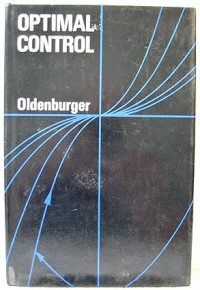
OPTIMAL CONTROL
This book presents the development and ar.'
plication of a theory of optimal control ia which the obyjective is to optimize on the basis of entire response curves, rather than by controlling single indexes of performance. Written . from the viewpoint of the automatic contro' engineer, it demonstrates to engineers anc: scientists the improvement to be gaired by transferring from conventional control methods to an optimal control system.
Extensive tests have been made to determine the validity of this approach. In papers published elsewhere, the author has delineated the principles, but not the proofs. In this book, the proofs are provided for the first time. Other recent work is also included. Nor:linear damping, multivariable systems, arbitrary disturbances, disturbances known in advance, dead times, and lead terms are some of the topics covered.
Most of the theory of this book is presented in the time domain because this is generally 'more familiar to the practicing engineer than the phase space approach. Furthermore, the proofs are not shortened by using the phase space method. However, some of the results for the phase plane are stated.
The problem of optimal control is especially important for adaptive control systems, where the controller must automatically match its own Characteristics to those of thc system. This is done by making the controller satisfy an Ooptimality criterion. The results here should lead to the successful optimal regulation of a “wide gfass of industrial systems.
Ketersediaan
Informasi Detail
- Judul Seri
-
-
- No. Panggil
-
510 OLD o
- Penerbit
- New York : Holt, Rinehart and Winston., 1966
- Deskripsi Fisik
-
vii, 239 p. : ill. ; 23 cm
- Bahasa
-
English
- ISBN/ISSN
-
978-1114318410
- Klasifikasi
-
510
- Tipe Isi
-
-
- Tipe Media
-
-
- Tipe Pembawa
-
-
- Edisi
-
-
- Subjek
-
-
- Info Detail Spesifik
-
-
- Pernyataan Tanggungjawab
-
Rufus Oldenburger
Versi lain/terkait
Tidak tersedia versi lain
Lampiran Berkas
Komentar
Anda harus masuk sebelum memberikan komentar






















 Karya Umum
  Filsafat
  Agama
Agama  Ilmu-ilmu Sosial
  Bahasa
  Ilmu-ilmu Murni
  Ilmu-ilmu Terapan
  Kesenian, Hiburan, dan Olahraga
  Kesusastraan
  Geografi dan Sejarah