Text
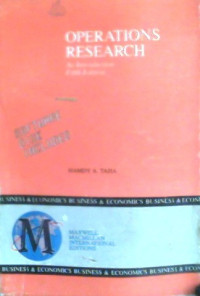
OPERATIONS RESEARCH AN INTRODUCTION FIFTH EDITION
This fifth edition is a major revision of Operations Research: An Introduction, Old topics have been thoroughly revamped and updated, ncw topics have been added, and software tailored to the needs of the book has been developed. The result is a volume that provides balanced coverage of the thcory, applications, and computations of operations research.
The book includes three parts and two appendixes. Part I on mathematical programming (Chapters 2 through 10) covers linear, integer, and dynamic program ming, as well as networks. Part II (Chapters 11 through 18) deals with probabilistic models that include data representation and analysis, PERT CPM, inventory, gueueing, Simulation, and Markov decisions. Part III (Chapters 19 and 20) covers classical and nonlinear optimization models. Appendix A reviews matrix algebra and Appendix B documents the TORA and SIMNET II software.
The material on linear programming has been revamped and consolidated. Starting with the first chapter, the two-dimensional graphical solution method is used effectively to explain the importance of dual values and reduced costs. These concepts, which form part of the TORA output, are used to interpret the results of interesting linear programming models. The succeeding chapters then introduce the necessary mathematical background that explains why the technigue works. The traditional topics of the primal/dual (regular and revised) simplex, transportation, upper bounding, and decomposition are all presented under the unifying theory of extreme point solution. Duality theory is used to explain the basics of sensitivity analysis and parametric programming. The material concludes with a presentation of the Karmarkar interior-point algorithm.
Ketersediaan
Informasi Detail
- Judul Seri
-
-
- No. Panggil
-
658.403.4 HAM o
- Penerbit
- New York : Macmillan., 1992
- Deskripsi Fisik
-
xix+820hlm: 24cm
- Bahasa
-
English
- ISBN/ISSN
-
0-02-48975-8
- Klasifikasi
-
658.403.4
- Tipe Isi
-
-
- Tipe Media
-
-
- Tipe Pembawa
-
-
- Edisi
-
Edisi 5
- Subjek
-
-
- Info Detail Spesifik
-
-
- Pernyataan Tanggungjawab
-
Hamdy A Taha
Versi lain/terkait
Tidak tersedia versi lain
Lampiran Berkas
Komentar
Anda harus masuk sebelum memberikan komentar























 Karya Umum
  Filsafat
  Agama
Agama  Ilmu-ilmu Sosial
  Bahasa
  Ilmu-ilmu Murni
  Ilmu-ilmu Terapan
  Kesenian, Hiburan, dan Olahraga
  Kesusastraan
  Geografi dan Sejarah