Text
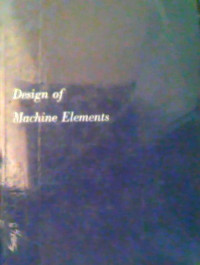
DESIGN OF MACHINE ELEMENTS THIRD EDITION
Io many machine elements have been stressed and overstressed since the previous edition that this is virtually a new book. The pedagogical objective of the first edition, to develop the subject matter clearly and logicallv for the benefit of the student, has been retained. But in this, the third edition, a further objeetive, to make the book more useful to the practicing engineer, has been added. It is believed that this added obyjective has made the book more interesting as well as more useful to the student. As a conseguence of the double objective, the teacher mav find that he cannot expect the student to master every detail meluded in the book unless some additional time is allotted to the subject. When the teacher omits 8 topic or touches it lightly, the student will be impressed with the shortcomings of what he is learning. Indeed, the student is repeatedly reminded that the treatments are necessarily brief in a work of this kind, and copious suggestions for further study have been provided.
It is believed that the material is organized in such a way that the student can learn more in the same length of time. As before, the emphasis is on the adaptation of theory to practical design. Realistic attitudes have been maintained throughout—by pointing out from time to time that there are no unigue answers to design problems and by .occasional estimations from limited facts. In short, there is emphasis on design attitudes and the exercise of judgment.
New design information has been included for nearly every machine element. New features are therefore so numerous that it is impractical to list all of them. Of special interest to many, however, will be the expanded treatment of variable stresses and fatigue. Addition of much material on these topies is fitting, inasmuch as the guantity of design information on these subjects has grcatly incrcased in recent years. Teachers will weleome the more detailed coverage of the mechanical properties of materials, Tables 2 to 10: the replacement of ITowartlys charts, obtained from graphical solutions of Reynold's eguation, by charts obtained from analytic solutions: the explanation of the fundamentals of rolling bearings, and many other practical improvements.
Ketersediaan
Informasi Detail
- Judul Seri
-
-
- No. Panggil
-
621.82 VIR d
- Penerbit
- New York : The Macmillan Company., 1964
- Deskripsi Fisik
-
xxii; 550hlm; 23cm
- Bahasa
-
English
- ISBN/ISSN
-
-
- Klasifikasi
-
621.82
- Tipe Isi
-
-
- Tipe Media
-
-
- Tipe Pembawa
-
-
- Edisi
-
Edisi 3
- Subjek
-
-
- Info Detail Spesifik
-
-
- Pernyataan Tanggungjawab
-
Virgil Moring Faires
Versi lain/terkait
Tidak tersedia versi lain
Lampiran Berkas
Komentar
Anda harus masuk sebelum memberikan komentar























 Karya Umum
  Filsafat
  Agama
Agama  Ilmu-ilmu Sosial
  Bahasa
  Ilmu-ilmu Murni
  Ilmu-ilmu Terapan
  Kesenian, Hiburan, dan Olahraga
  Kesusastraan
  Geografi dan Sejarah