Text
Wind-Waves In Oceans
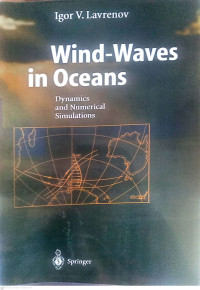
The study of sea waves has always been in the focus of mankind's attention. This is attributed not only to a desire to understand the behaviour in seas and oceans, but also, it has some practical necessity. Developing up-todate wind wave numerical methods reguires detailed mathematical modelling, starting with wave generation, development, propagation and transformation on the surface in different water areas under guasi-stationary conditions, up to a synthesis of climatic features observed under different wave generation conditions in oceans, sea or coastal areas. The present monograph considers wind waves in terms of the most general formulation of the problem as a probable hydrodynamic process with wide Spatial variability. It ranges between the global scale of the oceans, whose typical size is comparable with the Earth's radius, to the regional and local scales of the seas, including water areas limited in space with significant current or depth gradients in coastal zones, where waves cease their existence having propagated tens of thousand miles. The importance of mathematical wind wave modelling as a random hydrodynamic process with a wide range of spatial-temporal variability at different scales is due to the stricter reguirements for detailing, completeness and reliability of wave characteristic data. This is necessary for improving wave forecasting, elaborating principally new ocean diagnostic methods and means, and expanding areas of resource exploration of the world's oceans and their shelves. It is also important for an increasing number of tasks concerning special hydrometeorological (weather) services for marine and oceanic Operations. The essence of mathematical wind wave modelling in the ocean in conditions of spatial non-uniformity, taking into account currents, uneven bottoms and ice influencing the generation, evolution and propagation of wind waves, is presented in this monograph. Considerable attention has been given to this problem during the last few years, but the methodical presentation of the modern theory is undertaken here for the first time. The monograph begins with the most general problem formulation of the mathematical wind wave modeling of the world's oceans. Some new approaches and optimal numerical methods of the solution of the problem are presented. The Earth's spherical effect on wave propagation is considered for global distances in the ocean. The main attention is given to the problem of wave interaction with the bottom, non-uniform currents and ice cover. The effects of spectrum evolution, wave reflection and blocking are considered at a current. The monograph gives a spectral model description of “abnormal waves”, which are very dangerous to ship navigation. Practical recommendations are given, for the first time here, in order to estimate the wave elements in a non-uniform current. The monograph can be used by specialists from many disciplines: oceanographers, meteorologists, hydraulic engineers and others, whose activity is connected with the ocean. It may also be used as an additional textbook for students in higher educational establishments for its methodical presentation of problems concerning physics and mathematical wind wave modelling. Although the author's results serve as a basis for the monograph, I am sincerely grateful to persons who participated in scientific discussions, assisted in solving theoretical problems and carrying out field measurements at sea. They are V. Dymov, T. Pasechnik and others (Arctic and Antarctic Research Institute, St. Petersburg): I. Davidan, Ye. Gutshabash, V. Ryvkin, V. Rozhkov, L. Lopatukhin, B. Shatov and others (Branch of the State Oceanographic Institute in St. Petersburg): Yu. Abuzyarov and V. Ryabinin (Hydrometeorological Centre, Moscow): V. Zakharov, M. Zaslavskii and V. Krasitskii (Institute of Oceanology, the Russian Academy of Sciences): G. Matushevskiy and V. Polnikov (State Oceanographic Institute, Moscow): I. Kantarzhi (STANKIN): V. Korobov (NORDECO): S. Strekalov (Hydroproject, Moscow), E. Pelinovskiy (Institute of Applied Physics, Nizniy Novgorod): V. Kudriavtcev (Marine Hydrophysical Institute, Ukraine): V. Makin, G. Komen, and J. Onvlee (KNMI, Netherlands): F.J. Ocampo-Torres (CICESE, Mexico): D. Resio (ERDC, US), L. Cavaleri (ISDGM, Italy), H. Krogstad (NTNU, Norway), and G. Athanassoulis (NTUA, Greece). The author is also grateful to N. Yakovleva for her assistance in the design of the monograph, and S. Kozhevnikov and M. Arsenchuk for helping in translation. Acknowledgements. The monograph includes the results of some scientific programmes concerning fundamental studies and data retrieval undertaken at the Arctic and Antarctic Research Institute in 1994-2001 with support of the Russian Foundation for Basic Research (RFBR) - 01-05-64846 and by the INTAS Projects:99-666: 01-0025: 01-0234: 01-2156.
Ketersediaan
Informasi Detail
- Judul Seri
-
-
- No. Panggil
-
551.47 LAV w
- Penerbit
- Berlin : Springer., 2003
- Deskripsi Fisik
-
xi, 376 hlm.; 29 cm
- Bahasa
-
English
- ISBN/ISSN
-
978-3-642-07890-3
- Klasifikasi
-
551.47
- Tipe Isi
-
-
- Tipe Media
-
-
- Tipe Pembawa
-
-
- Edisi
-
-
- Subjek
- Info Detail Spesifik
-
-
- Pernyataan Tanggungjawab
-
Igor V. Lavrenov
Versi lain/terkait
Tidak tersedia versi lain
Lampiran Berkas
Komentar
Anda harus masuk sebelum memberikan komentar























 Karya Umum
  Filsafat
  Agama
Agama  Ilmu-ilmu Sosial
  Bahasa
  Ilmu-ilmu Murni
  Ilmu-ilmu Terapan
  Kesenian, Hiburan, dan Olahraga
  Kesusastraan
  Geografi dan Sejarah