Text
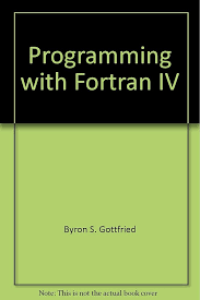
Programming With FORTRAN IV
Numerous books have been written on the subject of Fortran programming. The quality of these books varies from a few well-written textbooks, at one end of the spectrum, to the many dull. terse and highly technical reference manuals at the other. (Certain Fortran reference manuals are so poorly written that they are practically unintelligible to even an experienced Fortran programmer!) Even the better-written textbooks tend to concentrate exclusively, however, on the rules of Fortran. Little or no attention is given to general programming practices, such as program organization. compactness, generality, self-documentation, and so on. This book is meant to be an introductory text on digital computer programming at the Fortran level. It is not intended as a complete text on the Fortran language. The objectives of the book are to teach the reader how to organize and write efficient computer programs, to present the more commonly used features of Fortran IV. and to stress the importance of good programming practice- what some may refer to as the ""art"" of computer programming. The style of writing is deliberately elementary. This enables the book to be easily understood by a wide reader audience, ranging from high school students to practicing scientists and engineers. The text is particularly well suited to the undergraduate college level, either as a textbook for an elementary programming course, a supplementary text for a more comprehensive course in analytical techniques, or as an effective self-study guide. The required mathematical level does not go beyond high school algebra. Only the more commonly used features of Fortran IV are discussed in this book. In fact most of these features are available in the older Fortran 11. The author has taken certain liberties by describing some of these features in a less-than-general manner. It is the author's firm conviction that simplicity is far more important than completeness when teaching elementary programming- the more general material can easily be learned at a later time once the student has mastered the basic concepts and acquired some experience and self-confidence. The material is organized in such a way as to enable the reader to write complete, though elementary, programs as soon as possible. It is very important that the reader write such programs and run them on a computer concurrently with reading the text. This greatly enhances the beginning programmer's self-confidence and stimulates his interest in the subject. (Programming a computer is much like playing the drums-neither can be learned simply by studying a textbook!) Numerous examples are included as an integral part of the text. These include a number of comprehensive programming examples as well as the customary drill-type problems. In addition, a set of supplementary illustrative problems is included at the end of most chapters. The reader should study the examples and the illustrative problems carefully as he reads each chapter and begins to write his own programs.
Ketersediaan
Informasi Detail
- Judul Seri
-
-
- No. Panggil
-
001.642 GOT p
- Penerbit
- America : QUANTUM PUBLISHER., 1972
- Deskripsi Fisik
-
272 hlm; ilus tidak berwarna; 28 cm
- Bahasa
-
English
- ISBN/ISSN
-
0-13-730119-7
- Klasifikasi
-
001.642
- Tipe Isi
-
-
- Tipe Media
-
-
- Tipe Pembawa
-
-
- Edisi
-
-
- Subjek
- Info Detail Spesifik
-
-
- Pernyataan Tanggungjawab
-
Byron S.Gottfried
Versi lain/terkait
Tidak tersedia versi lain
Lampiran Berkas
Komentar
Anda harus masuk sebelum memberikan komentar























 Karya Umum
  Filsafat
  Agama
Agama  Ilmu-ilmu Sosial
  Bahasa
  Ilmu-ilmu Murni
  Ilmu-ilmu Terapan
  Kesenian, Hiburan, dan Olahraga
  Kesusastraan
  Geografi dan Sejarah