Text
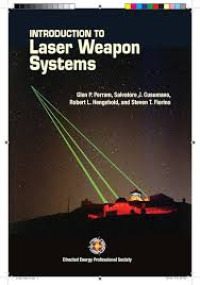
Introduction To Leaser Weapon Systems
"This course arises from an almost 40 year history of graduate studies in high energy lasers and optics at the Air Force Institute of Technology. In particular, a series of short courses for scientists and engineers new to the field of directed energy have been developed as summaries of graduate courses in lasers, optics, spectroscopy, atmospherics, systems engineering, and electro-optics. More recently, the Directed Energy Professional Society, with funding from the High Energy Laser Joint Technology Office, sponsored the development of a 32-hour short course entitled ""Laser Weapons Systems"" This textbook parallels the material presented in the course
This test is primarily intended for scientists and engineers with a bachelor of science degree However, many undergraduate students and non-degreed technicians often find the more conceptual material valuable. The course emphasizes concepts, terminology, current technology capabilities, and systems concepts The course does not develop key relationships from first principles 1 imitations on the effectiveness of HEL weapons and key performance trade-offs are addressed Applications of these concepts to current systems include the historical Airborne Laser Laboratory. Airborne Laser, Tactical High Energy Laser, Advanced Tactical Laser, and Space-Based Laser programs The course includes a number of extended work problems, including simplified calculations of weapon effectiveness for a high altitude, long-range, au to-air engagement and a short- range tactical scenario
The text covers a broad range of technical disciplmes, some in considerable depth, making a reasonable course for graduate students In a few chapters, the prerequisites in spectroscopy, chemical kinetics, optics, or laser physics may be challenging to the casual reader.
Many faculty members, research staff, and students at the Air Force Institute of Technology have contributed materials and ideas to this work, including William F. Bailey, Richard Bartell, Matthew Krizo, Matthew Goda, Mark Houle, Michael Marciniak, Won B. Roh, Adam Downs, David W. Weeks, J Jean Cohen, Brian Elliot, Christopher Cummings, Ryan Heap, Jamin McCue, and Victor Velten In addition, several collaborators from other academic institutions deserve considerable credit, including Paul Merritt, Jerry Clark, Peter Burban, Steven Gollmer, and Otis Wright. In-house editor Taylor Thompson tirelessly compiled, coordinated, and incorporated numerous changes, updates, and improvements. We also thank Sam Blankenship, executive director of the Directed Energy Professional Society for his encouragement and support."
Ketersediaan
Informasi Detail
- Judul Seri
-
-
- No. Panggil
-
621.384 8 GLE i
- Penerbit
- mexico : Directed Energy Professional Society., 2009
- Deskripsi Fisik
-
-
- Bahasa
-
English
- ISBN/ISSN
-
-
- Klasifikasi
-
621.384 8
- Tipe Isi
-
-
- Tipe Media
-
-
- Tipe Pembawa
-
-
- Edisi
-
-
- Subjek
- Info Detail Spesifik
-
-
- Pernyataan Tanggungjawab
-
Glen P.Perram
Versi lain/terkait
Tidak tersedia versi lain
Lampiran Berkas
Komentar
Anda harus masuk sebelum memberikan komentar























 Karya Umum
  Filsafat
  Agama
Agama  Ilmu-ilmu Sosial
  Bahasa
  Ilmu-ilmu Murni
  Ilmu-ilmu Terapan
  Kesenian, Hiburan, dan Olahraga
  Kesusastraan
  Geografi dan Sejarah