Text
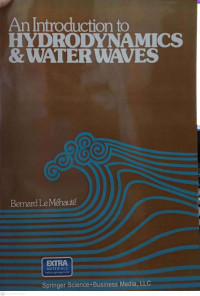
An Introduction to Hydronamics & Water Waves.
Hydrodynamics is the science which deals With the motion of liguid in the macroscopic sense. It is essentially a field which is regarded as applied mathematics because i deals with the mathematical treatments of basic eguationg for a fluid continuum obtained on a purely Newtonian basis. It is also the foundation of hydraulics, Which, as an art, has to compromise with the rigorous mathematicay treatments because of nonlinear effects, inherent instability, turbulence, and the complexity of “ boundary conditions” encountered in engineering practice. Therefore, this book can be considered as the text for a course in basic hydrodynamics, as well as for a course in the fundamentals of hydraulic and related engineering disciplines.
In the first case, the students learn how to make use of their mathematical knowledge in a field of physics particulariy suitable to mathematical treatments. Since they may have some difficulty in representing a physical phenomenon by a mathematical model, a great emphasis has been given to the physical concepts of hydrodynamics. For students with an undergraduate training in engineering, the difficulty may be a lack of appropriate mathematical tools. Their first contact with hydraulics has been on an essentially practical basis. They may be discouraged in attempting the study of such books as Hydrodynamics, by Lamb, which remains the bible of hydrodynamicists. Hence, mathematical intricacies have been introduced slowly and progressively. Also, the emphasis on the physical approach has made it possible to avoid mathematical abstractions s0 that a concrete support may be given to eguations.
Finally, the author has tried to make this book selfcontained in the sense that a practicing engineer who wants to improve his theoretical background can study hydrodynamics by himself without attending lectures. Too often articles in scientific journals present some discouraging aspects to practicing engineers and the most valuable messages can only reach a few specialists. It is felt that the learning of some basic theories will help hydraulic engineers to keep abreast of and participate in new develop
ments proposed by theorists. Considering that a good assimilation of the basis is essential before further study, great care has been taken to develop a clear understanding, both mathematically and physically, of the fundamental concepts of theoretical hydraulics. The introduction of mathematical simplifications and assumptions, often based on physical considerations, has also bcen developed by examples. The mathematical difficulties have been cicared up by introducing them progressively and by developing all the intermediate calculations. Also, all the abstract concepts of theoretical hydraulics have been explained as concretely as possible by use of examples. It will appear that the first chapter is the casiest to understand, and it is assumed that the mathematical background increases as the student progresses toward theend of the book. However, itis taken for granted that the student already has some notion of elementary hydraulics.
Finally, the succession of the various chapters have been chosen in order to build up a structure as logical and as deductive as possible in order to avoid that the various subjects appear as a succession of different mathematical recipes rather than as a unigue and logical subject.
Part One deals with the establishment of the fundamental differential eguations governing the flow motion in all possible cases. The possible approximations are also indicated. Part Two deals with general methods of integrations and the mathematical treatments of these eguations. Integrations of general interest, and integrations in some typical particular cases are presented. Part Three is devoted to water wave theories, as one of the most important topics of hydrodynamics.
It is pointed out that the emphasis of the book is on water waves. Therefore the treatment of motion of compressible fluids has been judged beyond the scope of this book, with a few exceptions. Also, almost all the calculations are presented in a Cartesian (or cylindrical) system of coordinates. Vectorial and tensorial operations have been minimized in order to reduce the necessary mathematical background. However, vectorial and tensorial notations are slowly introduced for sake of recognition in the literature.
Ketersediaan
Informasi Detail
- Judul Seri
-
-
- No. Panggil
-
532.5 MEH a
- Penerbit
- New York : Springer Science., 1976
- Deskripsi Fisik
-
viii, 315hlm; Ilus; 29cm
- Bahasa
-
- ISBN/ISSN
-
978-3-642-85569-6
- Klasifikasi
-
532.5
- Tipe Isi
-
-
- Tipe Media
-
-
- Tipe Pembawa
-
-
- Edisi
-
-
- Subjek
- Info Detail Spesifik
-
-
- Pernyataan Tanggungjawab
-
-
Versi lain/terkait
Tidak tersedia versi lain
Lampiran Berkas
Komentar
Anda harus masuk sebelum memberikan komentar























 Karya Umum
  Filsafat
  Agama
Agama  Ilmu-ilmu Sosial
  Bahasa
  Ilmu-ilmu Murni
  Ilmu-ilmu Terapan
  Kesenian, Hiburan, dan Olahraga
  Kesusastraan
  Geografi dan Sejarah