Text
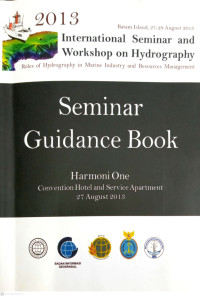
Seminar Guidance Book
First of all, I would like to thank to the Mighty God, Allah SWT and all supporung organizations and institutions who make this 2013 INTERNATIONAL SEMINAR AND WORKSHOP ON HYDROGRAPHY (ISWH 2013) happen. The event is organized by Indonesian Surveyor Association (ISI) and Indonesian Hydrographic Socety (MHI
together with Geospatial Information Agency (BIG), Hydro-Oceanographic Office (DISHIDROS) and National Land Agency (BPN). It is an honour for ISI and MHI to organize this first hydrographic-related seminar event in Indonesia. The seminar is jntended to identify development of science, technology as well as human resources in hydrography in the world, particularly Indonesia and ASEAN region to support sustainable development planning and maritime industry. Therefore we decide the theme of the seminar as Roles of Hydrography in Marine Industry and Resources Management.
As it is defined by International Hydrographic Organization (IHO), hydrography is the branch of science which is dealing with measurement and description of the nature and configuration of seabed and the dynamics of water bodies. Hydrography plays an important role in any aspect of maritime and coastal development. It is related to basic knowledge of the geographical, geological and geophysical features of the seabed and coast, as well the currents, tides and certain physical properties of the sea water. In brief, Hydrography is the key to progress on all maritime activities, normally of great national economic importance.
In addition to supporting safe and efficient navigation of ships, hydrography underpins almost every other activity associated with the sea, including resource exploitation, environmental protection and management, maritime boundary delimitation, national marine spatial data infrastructures, recreational boating, maritime defence and security, tsunami flood and inundation modelling, coastal zone management, tourism and marine science.
Indonesia, with 17,508 islands, 81,000 km of coastline, and 83.1 million km2 of maritime area is the largest archipelagic country in the world. Based on the United Nations Convention on the Law of the Sea 1982, Indonesia has a sovereign right to utilize and manage the Exclusive Economic Zone (EEZ) as large as 2.7 million km2. Its coastal and marine area has a huge number of both renewable as well as unrenewable resources. In order to utilize and manage the marine and coastal resources properly, it is reguired to have an appropriate geospatial data infrastructure for planning, execution, and evaluation, which are regulated by law and public policy.
Bathymetry, seabed features, as well the currents, tides and certain physical properties of the sea water are types of marine and coastal geospatial information. Related to the geospatial information, Indonesian Government has produced a National Law Nr. 4/2011 about Geospatial Information to assure availability of and access to responsible and accurate geospatial information as well as to establish expediency of those geospatial information.
Ketersediaan
Informasi Detail
- Judul Seri
-
-
- No. Panggil
-
551.46 SEM
- Penerbit
- Bandung : ITB., 2013
- Deskripsi Fisik
-
88hlm, 21cm
- Bahasa
-
- ISBN/ISSN
-
-
- Klasifikasi
-
551.46
- Tipe Isi
-
-
- Tipe Media
-
-
- Tipe Pembawa
-
-
- Edisi
-
-
- Subjek
- Info Detail Spesifik
-
-
- Pernyataan Tanggungjawab
-
-
Versi lain/terkait
Tidak tersedia versi lain
Lampiran Berkas
Komentar
Anda harus masuk sebelum memberikan komentar





















 Karya Umum
  Filsafat
  Agama
Agama  Ilmu-ilmu Sosial
  Bahasa
  Ilmu-ilmu Murni
  Ilmu-ilmu Terapan
  Kesenian, Hiburan, dan Olahraga
  Kesusastraan
  Geografi dan Sejarah