Text
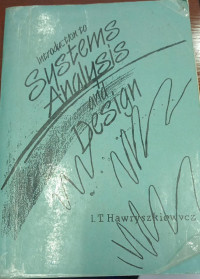
Introduction System Analysis and Design
Sy stems analysis has evolved dramarically over the last decade. Dyring the 1960s and ay 1970s, systems analysts used ad hoc methods to analyze a and design computerbased information systems. Many of these methods used natural' language to describe
systems and user reguirements. Few formal technigues existed. All chis changed during the 1970s. In that period many new ideas were introduced
to Overcome problems associated with ad hoc methods. One of these ideas was the use of modeling technigues instead of natural language for describing systems. Another idea was che distinction which was made berween logical and physical analysis and design. A third idea was the introduction of a structurzd way of moving from a
description of user needs to a working system. Since these ideas were first introduced, several supporting modeling technigues
have bcen developed and used in practice. These technigues apply structured methods to many aspects of systems analysis and design. One important set of technigues is known as srructured systems-analysis which concentrate on modeling data flows, deriving data structure and idenrifying system functions from these flows. Another set of technigues concentrates on dara, developing data models and using data analysis methods to construct these models. Process and flow are then defined around the data model. Data analysis technigues include relational analysis and 2 variety of semantic modeling technigues. Another set of technigues concentrates on funcrional analysis to
describe how dara is used and changed in the system. Unlike many of the books on this subject, this book as well as describing this wide
variety of systems analysis and design technigues, also shows how they can be integrated
into design methodologies. In addiaon the book shows how analysis can be integrated with design and how
systein models of flow, data and function can be converted to system specifications using a set of well-defined steps.
The book is written for beginners and does not assume any knowledge of systems analysis or design. However, it does assume that readers have some basic knowledge about computers. For example, readers should know that dara is stored on computer disks and thar these disks are controlled by a processor. Readers should also know that dara can be input into a computer through devices such as cards or through terminals and that outputs can then be obtained on the terminal screen or an output printer. Readers should also know that computers can communicate between themselves Or remote devices via commurications links. Some knowledge of programming and
algorithms is also useful but not essential.
Ketersediaan
Informasi Detail
- Judul Seri
-
-
- No. Panggil
-
003 HAW i
- Penerbit
- Australia : Prentice-Hall., 1988
- Deskripsi Fisik
-
xii, Ilus tak berwarna; 373 hlm, 23cm
- Bahasa
-
English
- ISBN/ISSN
-
0 7248 0662 8
- Klasifikasi
-
003
- Tipe Isi
-
-
- Tipe Media
-
-
- Tipe Pembawa
-
-
- Edisi
-
-
- Subjek
- Info Detail Spesifik
-
-
- Pernyataan Tanggungjawab
-
I. T. Hawryszkiewycz
Versi lain/terkait
Tidak tersedia versi lain
Lampiran Berkas
Komentar
Anda harus masuk sebelum memberikan komentar























 Karya Umum
  Filsafat
  Agama
Agama  Ilmu-ilmu Sosial
  Bahasa
  Ilmu-ilmu Murni
  Ilmu-ilmu Terapan
  Kesenian, Hiburan, dan Olahraga
  Kesusastraan
  Geografi dan Sejarah