Text
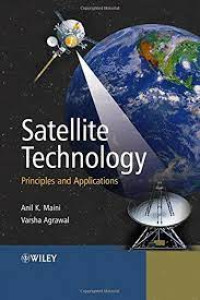
Satellite Technology : Principles and Applications
The word “satellite” is a household name today. It sounds very familiar to all of us irrespective of our educational and professional background. It is no longer the prerogative -of a few select nations and is not a topic of research and discussion that is confined to the premises of big academic institutes and research organizations. Today, it is not only one of the main subjects taught at undergraduate, graduate and postgraduate level: it is the bread and butter for a large percentage of electronics, communication and IT professionals working for academic institutes, science and technology organizations and industry. Most of the books on satellite technology and its applications cover only communicationsrelated applications of satellites, with cither occasional or no reference to other important applications, which include remote sensing, weather forecasting, scientific, navigational and military applications. Also, Space Encyclopaedias mainly cover the satellite missions and their applications with not much information on the technological aspects. The present book is a concise and yet comprehensive reference book on the subject of satellite technology and its applications, covering in one volume both communications as well as noncommunication applications. The intended audience for this book includes undergraduate and graduate level students and electronics, telecommunication and IT professionals looking for a compact and comprehensive reference book on satellite technology and its applications. The book is logically divided into two parts, namely satellite technology fundamentals Covered in Chapters 1 to 7, followed by satellite applications in Chapters 8 to 13. Tbe first introductory chapter begins with a brief account of the historical evolution of satellite technology, different types of satellite missions and areas of application of satellite technology. The next two chapters focus on orbital dynamics and related topics. The study of orbits and trajectories of satellites and satellite launch vehicles is the most fundamental topic Of the subject of satellite technology and also perhaps the most important one. It is important because it gives an insight into the operational aspects of this wonderful piece of technology. An understanding of the orbital dynamics would put us on a sound footing to address issucs like types of orbits and their suitability for a given application, orbit stabilization, Orbit correction and station-keeping, launch reguirements and typical launch trajectories for Various orbits, earth coverage and so on. These two chapters are well supported by the teguired mathematics and design illustrations. After addressing the fundamental issues related to the operational principle of satellites, the dynarnics of the satellite orbits, the launch procedures and various in-orbit operations, the focus in Chapter 4 is on satellite hardware, irrespective of its intended application. Difterent subsystems of a typical satellite and issues like the major functions performed by each one Of these subsystems along with a brief discussion of their operational considerations ara covered in thus chapter. After an introduction to the evolution of satellites, satellite orbital dynamics and hardware in the first four chapters, the focus shifts to topics that relate mainly to communication satellites in the three chapters thereafter. The topics covered in the first of the three chapters, Chapter 5, mainly include communication fundamentals with particular reference to satellite communication followed by multiple access technigues in the next chapter. Chapter 7 focuses on satellite link design related aspects. Satellite applications are in the second part of the book in Chapters 8 to 13. Based on the intended applications, the satellites are broadly classified as communication satellites, navigation satellites, weather forecasting satellites, Earth observation satellites, scientific satellites and military satellites. We intend to focus on this ever-expanding vast arena of satellite applications. The emphasis is on the underlying principles, the application potential and their contemporary status. Communication satellites account for more than 80 & of the total number of satellites in operation. This is one of the most widely exploited applications of satellites. The first chapter on satellite applications covers all the communication-related applications of satellites, which mainly include satellite telephony, satellite radio, satellite television and data broadcasting services. Major international communication satellite missions have also been described at length. Remote sensing is a technology used for obtaining information about the characteristics of an object through an analysis of the data acguired from it at a distance. Satellites play an important role in remote sensing. In Chapter 9, various topics related to remote sensing satellites are covered, including their principle of operation, payloads on board these satellites and their use to acguire images, processing and analysis of these images using various digital imaging technigues, and finally interpreting these images for studying various features of Earth for varied applications. We also introduce some of the major remote sensing satellite systems used for the purpose towards the end of the chapter. The use of satellites for weather forecasting and prediction of related phenomena has become indispensable. There is a permanent demand from the media with the reguirement of short term weather forecasts for the general public, reliable prediction of the movements of tropical cyclones allow re-routing of shipping and a preventive action in zones through which burricanes pass. Meteorological information is also of considerable importance for the conduct of military operations such as reconnaissance missions. In Chapter 10, we take a closer look at various aspects related to evolution, operation and use of weather satellites. Some of the major weather satellite missions are covered towards the end of the chapter. Like previous chapters on satellite applications, this chapter also contains & large number of illustrative photographs. Navigation is the art of determining the position of a platform or an object at any specified time. Satellite-based navigation systems represent a breakthrough in this field, which has revolutionized the very concept and application potential of navigation. These systems have grown from a relatively humble beginning as a support technology to that of & critical player used in the vast array of economic, scientific, civilian and military applications Chapter 11 gives a brief outline of tbe development of satellite-based navigation systems and a descriptive view of the fundamentals underlying the operation of the GPS and the GLONASS navigation systems, their functioning and applications. The use of satellites for scientific research has removed the constraints like attenuation and blocking of radiation by the Earth's atmosphere, gravitational effects on measurements and difficulty in making in situ studies imposed by the Earth-based observations. Moreover, space-based scientific research is global by nature and helps to give an understanding of the various phenomena at a global level. Chapter 12 focuses on the scientific applications of satellites, covering in detail the contributions made by these satellites to Earth sciences, solar physics, astronomy and astrophysics. Military systems of today rely heavily on the use of satellites both during war as well as in peacetime. Many of the military satellites perform roles similar to their civilian counterparts, mainly including telecommunication services, weather forecasting, navigation and Earth observation applications. Though some satellite missions are exclusively military in nature, many contemporary satellite systems are dual-use satellites that are used both for military as well as civilian applications. In the concluding chapter of the book, we deliberate on various facets of military satellites related to their development and application potential. We begin , the chapter with an overview of military satellites, followed by a description of various types of military satellites depending upon their intended application. As an extra resource, the companion website for our book contains a complete compendium of the features and facilities of satellites and satellite launch vehicles from past, present and planned futuristic satellite missions for various applications. Please go to www.wiley.com/go/maini. Colour versions of some of the figures within the book are also available. The motivation to write the proposed book and the selection of topics covered lay in the absence of any book which in one volume would cover all the important aspects of satellite technology and its applications. There are space encyclopaedias that provide detailed information/technical data on the satellites launched by various countries for various applications, but contain virtually no information on the principles of satellite technology. There are a host of books on satellite communications, which discuss satellite technology with a focus on communications-related applications. We have made an honest attempt to offer to our intended audience, mainly electronics, telecommunication and IT professionals, a concise yet comprehensive reference book covering in one volume both the technology as Well as the application-related aspects of satellites.
Ketersediaan
Informasi Detail
- Judul Seri
-
-
- No. Panggil
-
629.424 ANI s
- Penerbit
- UK : John Wiley & Sons., 2007
- Deskripsi Fisik
-
xvii, 558 hlm. ; ilus, tidak berwarna ; 24 cm.
- Bahasa
-
English
- ISBN/ISSN
-
978-0-470-66024-9
- Klasifikasi
-
629.434
- Tipe Isi
-
-
- Tipe Media
-
-
- Tipe Pembawa
-
-
- Edisi
-
-
- Subjek
- Info Detail Spesifik
-
-
- Pernyataan Tanggungjawab
-
Anil K. Maini, Varsha Agrawal
Versi lain/terkait
Tidak tersedia versi lain
Lampiran Berkas
Komentar
Anda harus masuk sebelum memberikan komentar























 Karya Umum
  Filsafat
  Agama
Agama  Ilmu-ilmu Sosial
  Bahasa
  Ilmu-ilmu Murni
  Ilmu-ilmu Terapan
  Kesenian, Hiburan, dan Olahraga
  Kesusastraan
  Geografi dan Sejarah